Showing posts with label definition. Show all posts

Saturday, 22 October 2011

Laytime & Demurrage: A Back-to-Basics Guide

One of the more mysterious elements of shipping law, at least to the uninitiated, are the issues of laytime and demurrage. I thought, for this reason, that it might be useful to do a 'bare bones' guide to the area. As with other areas identified many people use the terminology incorrectly so don't get confused by people saying apparently contradictory things. 


This area of shipping law deals with the general principle that if you charter (hire) a ship to move cargo from A to B at a set price (i.e. a voyage charter), then you should pay the ship compensation if it gets held up whilst loading or discharging the cargo you wanted to move, i.e. if you delay in getting your goods to the port and the ship's journey takes 2 days longer as a result, you should compensate the ship for those 2 days lost. Here is the framework that has developed, in simple terms. 

Ships are not like trains and cannot confirm absolute timetables for being in place A to B, especially when they are 'tramping' (just going where ordered next and not between set ports). So, when you enter a charterparty to hire a ship to move your goods the ship is given Laydays, being the period of days in which the ship can arrive to load your goods. After this point comes the Cancelling Date; if the ship is not there by this date the charterer may cancel the contract, basically because the ship is so late they either no longer wish to move the goods or wish to use another ship. This period is sometimes referred to altogether as the Laycan (Laydays + Cancelling).

When the ship arrives to load or discharge it tenders a Notice of Readiness (NOR) to the charterer, stating that they are ready to load / discharge. After a period of time (normally 6 hours) of giving notification it is considered reasonable for the charterers to have been able to start loading, so Layitme starts to run. Laytime is a period of time set out in the charterparty which gives the charterer an allowance for time to load (often 36 hours, but depends on trade and means of loading - oil tankers load faster than bulk cargo for instance). Once the charterers used up their laytime allowance time switches to Demurrage. Demurrage is a rate of compensation per day (or pro rata per hour) that they must pay to the shipowner for holding up the ship for longer than agreed. 

If the ship is held up for reasons for which the charterer is responsible but outside the running of laytime / demurrage then the shipowner can sue the charterer for Detention. Usually the compensation awarded for detaining the ship is the same as the demurrage rate, because the parties have already agreed a convenient compensation calculation for using the ship's time outside the contract so it is easy for the courts to apply this rate. 

Friday, 25 February 2011

GUIDE: Hull & Machinery Insurance

Hull and Machinery insurance is a form of marine insurance which pays the owner for damage done to the ship itself or the equipment which forms part of it (for instance, cranes, hydraulic winches etc.). it is often simply known as hull insurance or hull cover.

It is possible to buy a much cheaper insurance ('TLO') for the hull risk, which covers Total Loss Only. In other words, if the vessel is damaged you must repair it at your own cost; the policy will only respond if the vessel is a total loss (by paying you what it was worth so that you can purchase a new one).

Most hull brokers will be able to obtain the best overall cover by blending an H&M policy which excludes total loss with a standalone Total Loss Only policy. The latter policy would find most vessels never making a claim and could therefore be bought relatively cheaply and as the H&M policy excludes the largest risk possible (for loss of the vessel) it too would be comparatively cheap.

The rationale from an underwriting side is that both insurers can more accurately identify the risk in what they are underwriting and can therefore be more specific in how much premium they charge.

Linked Insurances 
Increased Value - For well known reasons, the Marine Insurance Act only allows you to buy cover for things in which you have an 'insurable interest'.  For this reason, H&M insurance is limited to the market value of your vessel. However, it was gradually realised that as a shipowner, if you lose your vessel, you will incur a great deal of costs which exceed the mere cost of buying a new one. Therefore, a new insurance became available, calling 'hull interest' or 'increased value' or 'IV', to provide cover for this. It generally entitles you to a payment of 20% - 25% of the vessel's value in the event the vessel is a total loss. This will be paid in addition to the main H&M settlement for the vessel's value.

War & Strikes - Losses related to war and strikes are excluded from normal H&M cover, but you can buy an additional cover which replaces this exclusion (albeit some elements of the exclusion like Nuclear cannot be bought back).

K&R - Kidnap and ransom insurance became more popular again in the 2000s, with an upsurge in attacks in Somalia, South East Asia and West Africa. It pays the cost of negotiating release of the crew and / or ship, in the event they are taken by pirates.

RDC/FFO - Most H&M policies include only 3/4ths cover for collision risk, and none for FFO (damage to fixed of floating objects) risk. However, today many H&M insurers allow you to add full cover for collision risk or cover for FFO risks to their policy. It is important to ensure your P&I then excludes these risks, in a way which dovetails with your additional H&M cover, as otherwise you will have a Double Insurance position, which will be procedurally and legally problematic in the event of a claim; and you will obviously not be paying premium efficiently if you are paying to insure the same risk twice, but can only claim once.

Wednesday, 23 February 2011

Acronyms

This is a collection of terms that I have built up after being asked by someone what something means or which I have heard people appear to misunderstand. I have endeavoured to explain each in simple terms.For my list of general terms please see my Glossary.


AB - Able-Bodied Seaman. A general crewmember onboard a vessel, in good health and with a general knowledge of working onboard a ship.

AIS - Automatic Identification System. This is a modern system for identifying ships and their exact locations / movements. Ships have AIS equipment onbaord which transmits information which gives the ships details and GPS coordinates. This information can be used by VTS operators, ports etc. for day to day interaction with the ship and logged by ship tracking systems (Seaweb, Lloyds MIU etc.) for long term records of a ships movements.

AOV - Any One Vessel.


AUV - Autonomous Underwater Vehicle. This is a subcategory of UUV submersible craft which can function without an operator at all, scanning the seabed using set parameters, for example.

AWIWL - Always Within Institute Warranties Limits.

CBA - Collective Bargaining Agreement. This is a document which acts as an extension to a group of employment contracts, usually for crewmembers onboard vessels. In general an employer who has a certain number of staff will be approached by a representitive of the employees as a group, who will negotiate terms which will be incorporated into all their agreements. It typically acts to fix compensation for injuries or provision of care for employees who fall ill.

C/M - Crewmember. A common industry shorthand.

DO - Diesel Oil. To distinguish from ship's bunkers.

ETA - Estimates Time of Arrival. Where followed by a location the time estimated to arrive at that location (e.g. ETA Liverpool 14:00 GMT).

ETD - Estimated time of Departure.


FFO - Fixed or Floating Object. This term is used to describe an incident where a ship hits something fixed or floating (but not another vessel, that would be a collision) and causes damage to it; for instance where a ship crushes a wooden pier (fixed) or dents a navigational buoy (floating). You will hear people talk of an 'FFO claim' accordingly. Some insurance policies will use the term 'fixed or moving object', to encompass claims where a ship damages third party property which is neither fixed nor floating (i.e. a delivery truck ashore).


IRTC - Internationally Recognised Transit Corridor. This is an area which has been marked out in the Gulf, in order to try to prevent Pirate attacks on vessels off the East-Coast of Africa. Discussions narrowed down the most popular route, furtherst from the cost and with least risk of attack and it is now recommended that all vessels use this when navigating the area for safety.

LS - Lump Sum.

MFV - Motor Fishing Vessel. Most ships powered mainly by engine are referred to as 'MV' so this is just a more specific title where the vessel is used for fishing.

NLRC - National Labour Relations Commission. The equivelant of an employmetn tribunal in the Philippines

OFC - Office.

OWS - Oily Water Separator. Most commercial ships have bilge wells which collect bilge water; a combination of water drained off from various sources on board which can include water from mechanical leaks and it normally contains oily residues. Bilge water generally needs to be pumped overboard to maintain the ships stability, but in line with international conventions (MARPOL) the oil in the water must be separated before thesis done. This is then normally done by an overboard pipe.

PDPR - Per Dar Pro Rata. This normally appears in charterparty wordings against an amount. 'USD 1,000 PDPR' means that if you are referring to 2 hours the relevant amount is USD 83.

POEA - Philippines Overseas Employment Administration. An organisation which represents Filipino crewmembers on foreign vessels. They assist mainly with the creation of collective bargaining agreements and providing standard contract terms for employment.

RDC - Running Down Clause. An old fashioned term for a a collsion with another vessel is 'running down', and therefore the clause in a marine insurance policy which relates to collision claims is often called the 'Running Down Clause' or 'RDC'.

ROB - Remaining on Board. Use in vessel shorthand, for instance, 'bunker spill occurred, ship now grounded and leakage stopped, 10 mt of Bunkers ROB.

PAX - Passenger. A commonly industry shorthand, i.e. 'hit by rogue wave, some damage to stern windows, no PAX injuries'.

ROV - Remotely Operated Vehicle. This is a description of a category of small machines which are designed to operate underwater without a controller onboard, but being operated by someone onboard a larger vessel on the surface, usually they will use a remote control of some form linked to the unit by electrical cable. It is a subcategory within the UUV group of marine equipment and includes, for instance, robots which can film deep sea wrecks.

SITREP - Situation Report. Shorthand for an update provided on a particular situation.

TTL - Total. Commonly used in fixture notes for charterparties.

TEU - Twenty-foot Equivelant Unit. This is the term for measurement of how many containers a ship can take onboard based on the maximum number of original twenty foot long container units it could carry. Of course sometimes a 40 foot container or other structure may be used in some areas of the ship, so a 10,000 TEU ship may be full laden but carrying a lot less than 10,000 individual containers, so giving the number of TEU it is capable of carrying is a better way of comparing it with other ships. Some people use the words Totally Enclosed Unit instead but it refers to the same thing.


UUV - Unmanned Underwater Vehicle. This is a group of small submerged craft, designed to be operated from a surface vessel, but with with no one actually onboard (not including, for instance, mini-submarines). This group of underwater equipment includes ROVs and AUVs.

VSL - Vessel - A commonly industry shorthand.

VTS - Vessel Traffic Services. This is the term for an organisation which controls vessel traffic in a given area. Usually controlling movement of ships and boats on a busy river or near a port.

WP - Generally this means Without Prejudice, which is a short for of saying without prejudice to our rights or position in law (i.e. if someone accuses you of a wrong against them you may feel that you did not commit it or do not know whether it happened but wish to get rid of the problem by offering them some money but you would do so 'WP', i.e. if they didn't accept it you would not want them showing the offer of money to the judge as proof that you did commit the wrong, the offer would be without prejudice, or damage, to, your rights). However, I have also seen this used in c/p's to mean 'Weather Permitting' (i.e. vessel to begin loading WP, 10/10/2012).

WWWW - This is a term often found in charterparties. It sets out the conditions when a Notice of Readiness can be tendered, to confirm that a vessel has arrived in port for the purposes of commencement of laytime. As an acronym of four separate acronyms it can be quite confusing. It means WIBON (whether in berth or not), WCCON (whether customs cleared or not), WIFPON (whether in free pratique or not) and WIPON (whether in port or not).

Tuesday, 22 February 2011

GUIDE: Cargo Claims

Cargo claims are claims for compensation made against a carrier for loss of or damage to cargo which they carried for reward. These claims are usually brought by owners of the cargo, in contract, based on an allaegation that by damaging the cargo whilst in their custody the carrier breached an express or implied term of the contract.

Subrogation
Most cargo claims against shipowners are brought not by the owners of damaged cargo but by their insurers. As covered in our 'Cargo Insurance' guide, when a party moves cargo they will normally take out insurance to protect them against its loss or damage. These insurance policies typically state that claims will be paid once the cost of the loss or damage to the cargo is known (i.e. they do not require the cargo owner to pursue any legal recourse against the responsible party first).

The reason for this is that most of these policies have a 'subrogation' clause, whcih requires the assured to allow the insurer to pursue a claim against any responsible party where a claim is paid under the policy. The insurance compamny will not have a dircet legal recourse, in contract or tort, against a responsible carrier so any claim they bring would have to be brought in the name of the cargo owner, for which the insurance company would clearly require their permission and cooperation.

Subrogated rights can be evidenced on a form of subrogation signed by the cargo owner / insured and addressed to their insurer. These forms are often sent along with claim settlement cheques where the insurer considers that there may be a legal recourse for damage done to property during tranit.  

Terms
Responsibility for cargo loss / damage will generally turn on evidence of causation and terms of the contract. The contract terms will generally be found in the Bill of Lading, Charterparty or other prevailing carriage document and will usually be subject to one of the main international conventions on the carriage of goods by sea (Hague Rules, Hague Visby Rules, Hamburg Rules etc.). Which convention applies will depend on the countries of transit and the proposed law and jurisdiction of the contract.  

Wednesday, 1 September 2010

Glossary

This is a collection of terms that I have built up after being asked by someone what something means or which I have heard people appear to misunderstand. I have endeavoured to explain each in simple terms.

Click here for my list of industry acronyms.

Actual Total Loss - A reference to a vessel which has been completely destroyed or irretrievably lost. For example where a boat is broken to pieces in a storm and scattered by the sea or where a ship sinks in very deep water. Can be contrasted with Constructive Total Loss (below).

Air Draught - Refers to the space available above water, for instance to warn of low handing objects of cranes.


Allision - Contact between a ship and some fixed object like a quay or shore crane.

Anchorage - An area where vessels can safely drop anchor and stay, usually close to a port.

Bunkers - The fuel used on ships, i.e. people will often say the ship is going into port to 'take on bunkers'. The term can actually apply to any form of fuel oil which is used onbaord a ship, it doesn't have to be used in the ship's main engine. Therefore even diesel oil used by equipment onboard can be said to be 'bunkers'. Lub oil would not however be classed as bunkers because it is not fuel.

Butterfly Valve - This is a type of valve used in pipes or pipelines which allows the pipe to be closed or flow through it limited, from the outside. This is done by turning a handle or moving an actuator (often controlled by a motor) on the outside of the pipe which turns a circular piece inside the pipe which can close off the pipe. When turned completely sideways the pipe is fully open. A picture of the pipe design is available here. Because defects in the valve are only usually noticeable after a failure occurs (the working mechanism is invisible from the outside) this can lead to incidents onboard.

Butterworthing - This describes the system of cleaning the tanks onboard a vessel with a special hose with multiple nozzles, like this, which spray high pressure water in all directions. The system was used by, and hoses produced by, a company called Butterworth, which resulted in the type of tank cleaning being described as Butterworthing (much like how 'vacuum cleaning' became 'hoovering').

Common Carrier - Most 'carriers' for the purpose of shipping law are contractual carriers, in other words they carry cargo or people against a Bill of Lading or passenger ticket, i.e. on agreed terms. There do still exist what are known as 'common carriers' who basically agree to move certain goods or people based only on common law terms. They generally issue no documents with terms on them and carry lots of small amounts of goods or people on short journeys and wish to keep admin' costs low. The equivalent on land would be a public bus, where someone can jump on and off without agreeing any carriage terms.

Constructive Total Loss (CTL) - This is a reference to a vessel which is being treated as a total loss for insurance purposes even though it is physically still there. This generally applies where the cost of salvaging the vessel or making it usable again is greater than the value of the vessel itself (i.e. greater than the cost of buying another similar vessel). For example where a ship worth USD 50,000 is grounded and a hole is punctured in its hull, the quoted cost of patching the hull, towing it to port and fully repairing it might be USD 75,000. In the circumstances its owners would call their hull insurers and tell them they were treating it as a CTL.

Ice Demurrage - This is a type of Demurrage which uniquely occurrs when a port that a charterer has asked a ship to go to is closed or blocked due to ice. Generally the ship will be able to claim demurrage for the resultant delays at the standard demurrage rate as it is a risk of the charterer, trading in such areas, that the ports will be closed and it is generally considered that the price of the goods involved will 'factor in' such risks and costs.

Zodiac - This is a type of small, inflatible boat. They get their name from the manufacturers, Zodiac, but the boats have proven so popular in their field that in the same way peolpe might describe any vaccum cleaner  as a Hoover, any boat mathcing this description is sometimes referred to as a Zodiac.

GUIDE: Collision Claims

Collision claims, also known as RDC claims*, involve incidents where two ships have made contact, or in layman's terms when two ships have hit each other. 


Liability
Where a collision occurs which is 100% the fault of one vessel, that vessel shall bear its own losses and compensate the other for its losses as a result of the collision. However, because of their very nature collisions almost always involve a degree of fault by each party involved. The general rule is therefore that the total damage is calculated and the % liability of each vessel for causing the collision is calculated and each vessel's owners pay their fair percentage of the total damage.  


Time Limit for Claims
Collision claims are, in most jurisdictions, subject to a two-year time limit, which runs from the date on which the collision occurs. This limit comes from the 1910 Collision Convention, which most countries have ratified.**


Wash Damage
At law claims for 'wash damage' (where the movement of one vessel creates waves in the water which damage other vessels) are generally considered collision claims and dealt with as such by the courts. This is the case even though there is no physical contact between the ships. It is important to note that, despite this, the wording of some P&I and Hull policies will be such that wash damage claims cannot be considered as collisions (if they cover 'contact' with a third party vessel for example).


FFO Claims
When a ship makes contact with property other than another vessel (shore cranes, bridges etc.) and causes damage to it, this is not considered a 'collision'. Technically it is an 'allision' (two moving objects collide with each other, whereas one moving object allides with a fixed object). This term is less common today and these claims are more frequently known as FFO claims, which stands for 'Fixed and Floating Object' claims. Hitting a quay would be an example of damage to a fixed object and cracking a navigational buoy would be an example of damage to a floating object).


* This is the old terms for collisions and stands for 'Running Down Collision', essentially a reference to when one ship ran down, i.e. into, another. 
** Convention for the Unification of Certain Rules of Law with respect to Collisions between Vessels (Brussels, 23 September 1910)

Saturday, 10 July 2010

Q: Docked / Berthed / Moored / Anchored?

All these terms refer to a vessel which is secured in a more or less fixed position.

When a vessel is in port to collect/disembark passengers or load/discharge cargo it will be, in a sense, connected to the dock (the functional area of pier) and is therefore 'docked'. A docked ship is typically a large one and will have several crew present on it, even when it is there overnight. Generally a ship is docked for a specific purpose, and when that task is complete the vessel will move on.

A berth, on the other hand, is a bit like the nautical equivalent of a parking space. Typically you buy one or lease one for a long period as somewhere to store your boat. To maximise space, 'berthed' vessels are typically kept perpendicular to (pointed at) the main jetty or pier, rather than a docked ship which is typically parallel to (in line with) the dock.

Any ship which is secured by ropes to a permanent fixture is 'moored' to that fixture. So 'moored' can be quite a broad description, although it is most appropriately used to described a vessel which is being kept at 'moorings'. Moorings are areas of water where boats and yachts can be secured to a fixed object on the seabed, usually a large concrete block with a rope attached and a buoy on the end. They are cheaper than berths to rent and are more secure (people cannot simply walk up to your boat). They tend to be used for the storage of boats or yachts when not in use, so moored vessels tend to have no one on board.

The most independent way to secure a vessel is to drop anchor. So long as the anchor has a certain amount of purchase on the seabed the ship will not move too far from its current location and is therefore described as being 'anchored'. This is the most independent but also the least secure way to station your boat, and as such a ship which is anchored is usually only staying in place for a short time and will almost always have someone on board.

Sunday, 4 July 2010

GUIDE: Contracts of Affreightment

There are two basic types of contract of affreightment:
1)      Bills of Lading; and
2       Charterparties.
~  o  ~

BILLS OF LADING

A document issued by a carrier, to a shipper, acknowledging that goods have been shipped on board for conveyance to a specified party and place.”

A Bill of Lading has three main purposes:
a)     1. It acts as a receipt for the goods, showing the carrier took possession of them,
b)     2. It is evidence of a contract of carriage,
c)      3. It is a document of transfer, being freely transferable.

Common Types of Bill

Straight Bill – This is a non-negotiable Bill, stating clearly the consignee’s name. It can be endorsed over, but it is risky as if the carrier had for instance a maritime lien over the goods, the endorsee is bound by it in the same way the

Sea-Waybill – This is simply a receipt for cargo, and not a document of title. It is not transferable or negotiable. It is commonly used today when a company is shipping goods between branches in different countries, or where the cargo will arrive with the consignee before the original documents do.

Through / Multimodal / Combined Bill – Cargo carried under this type of Bill of Lading will go right through to destination, in other words by sea then by rail, or road or airfreight.

House Bill – The covering Bill to the real Ocean or Master Bill, issued by a freight forwarder.

Liner Bill – A Bill of Lading issued by a carrier that provides a regular service on a specified route. 

The Process
* Generally, once cargo has been shipped (or sometimes before) three original Bills of Lading are drawn up by the carrier, and one is given to the shipper. The information is usually just that supplied by the shipper.
* Sometimes the shipper draws it up and the carrier merely signs it, but this is unusual.
* They should not bear a date that is earlier than the date on which the cargo was fully loaded on board (The Wilomi Tanana [1993]).

Identifying the Carrier from the Bill of Lading
* The court will look at the logo printer on the Bill, the signature and wording of the signature box, and the terms on the back; specifically whether there is an IOC (Identity of Carrier) Clause.


CHARTERPARTIES
“This is a contract between a shipowner and someone who wishes to hire o let their ship, for a period of time or for a particular voyage.”

Types of Charterparty

Time Charterparty – This is where you hire the ship for a set period of time. The owner remains in charge of it but you can take it where you like, transporting what you like. You pay a fee plus the fuel you use and port charges you incur. 

Demise / Bareboat Charterparty – This is a sub-type of Time Chartering, where a ship is hired for a long period (years) and the charterer provides crew, insurance, maintenance themselves. Often the charterer obtains ownership after a set period of payments, and the Charterparty therefore acts as a form of finance (like HP on a car) for the sale of the ship.

Voyage Charterparty – This is where a cargo interest just charters a ship for one particular job (moving a bulk pig iron purchase from Rio to Beijing for instance). No crew costs, fuel costs or port charges are passed on by the owner, there is usually only one catch-all fee (but the charterer pays the stevedores). A miniature version is a Slot Charter Agreement, where a carrier agrees to give a charterer a certain number of container slots on a voyage from x to y.


COMMON CLAUSES IN C/P WORDINGS

Bunker Clause (Fuel Clause) – The charterer agrees to pay owners for all fuel on the vessel at the time of taking it over (delivery) - at the market rate at the port of delivery. The owner agrees to do the same to the charterer with any fuel left at the port where the vessel is returned to owners (port of redelivery).

Ship Clause – The owner of the ship warrants that the ship will be seaworthy in every respect at the point of delivery or beginning of the voyage.

Ice clause – Inserted when the ship is headed for a port which may be closed due to ice.

Lighterage Clause – Usually spells out that vessel can deliver goods near the port (for onwards transit by lighter) instead of exactly at it if necessary. Sometimes also declares that the delivery can be at any port in a certain range – Thamesport, Tilbury or Felixstowre for example.

Negligence Clause – Typically excludes shipowner’s liability for loss or damage to the goods during transit, save for a lack of due diligence by them.

Ready Berth Clause – Essntially says that shipowners have completed their job once they have arrived at the delivery port, and not once berthed , as in many ports they may have to wait for a berth and they will not pay the costs of this, and indeed the ship will charge for any laydays spent waiting for such a berth.

COMMON WORDINGS

Because of the complex nature of charterparty agreements and the number of clauses and safeguards that need to be built in to satisfy each party generally a charterparty agreement is entered into on a standard industry wording, such as a Gencon, Heavycon, Barecon etc., as appropriate. Sometimes the satandard wording is used, but more commonly an amended form of that wording is agreed, with some clauses removed, added and / or amended.

Saturday, 3 July 2010

Q: What is the Difference Between a Boat, a Ship and a Vessel?


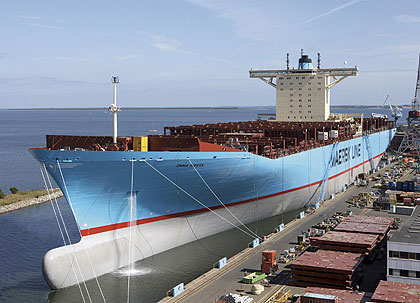
Vessel is a catch-all term, like 'watercraft', which describes any floating object used for the carriage of people or goods. Generally smaller and less complex vessels are 'boats', whilst larger and more complex vessels are 'ships'. As a general rule, you can put a boat on a ship, but you can't put a ship on a boat. 

Specifically, boats are small to medium-sized vessels with hulls,* powered by sails, engines, or human force. Some types of vessel are always categorised as boats, regardless of their size or complexity.** Their 'boat' status was designated when these types of vessel were small and has stuck despite their future growth.

A ship is a larger vessel, built to transport either passengers or cargo. These types of vessel started off large and accordingly we talk of a cruiseships, containerships and a battleships.

* a raft, for instance, has no hull; it would therefore be incorrect to call it a boat - hence 'life raft'.
**  submarines, fishing boats, tugs and barges for example.


(Image Credit: John Keogh)

  © Blogger template 'Isolation' by Ourblogtemplates.com 2008

Back to TOP